



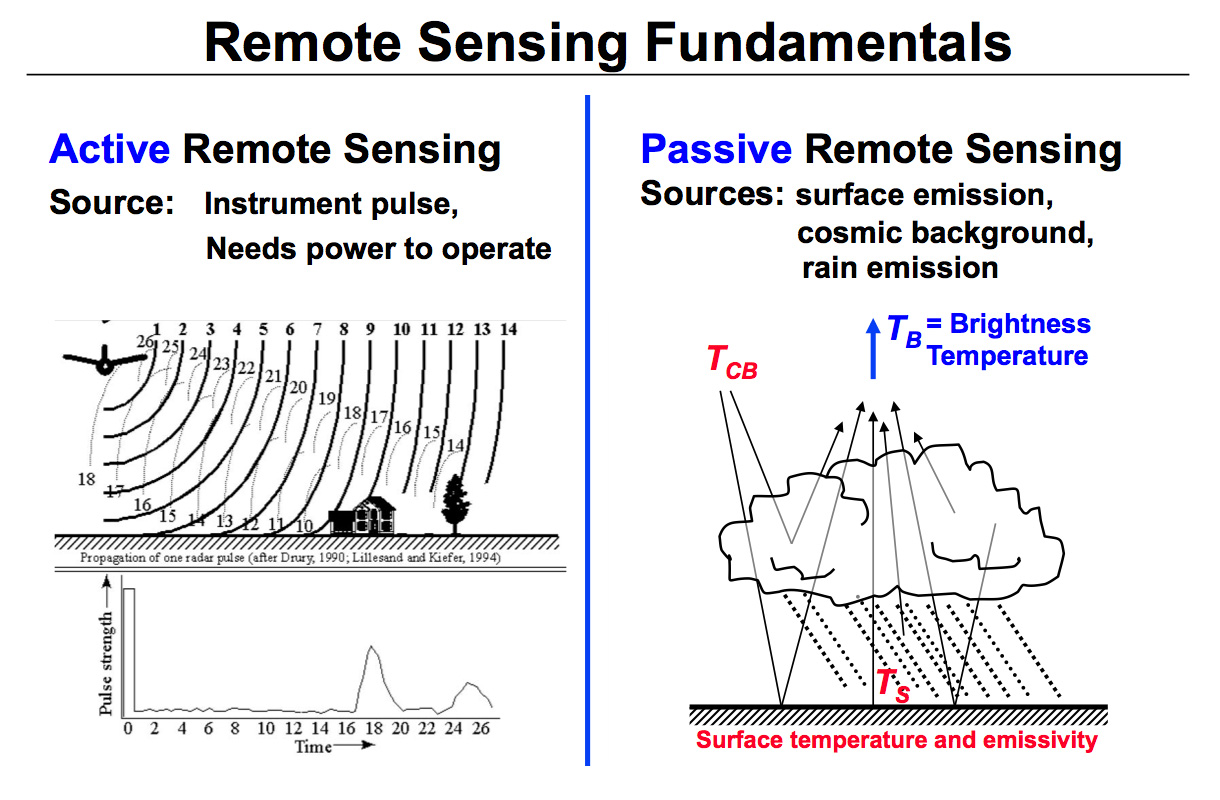
This diagram illustrates the differences between active and passive remote sensing.
TRMM and GPM rely on active and passive instruments to measure the properties of precipitation from space.
Active radars, such as the TRMM Precipitation Radar, transmit and receive signals reflected back to the radar. The signal returned to the radar receiver (called radar reflectivity) provides a measure of the size and number of rain/snow drops at multiple vertical layers in the cloud (Left figure).
Passive precipitation radiometers, such as the TRMM Microwave Imager, measure natural thermal radiation (called brightness temperatures) from the complete observational scene including snow, rain, clouds, and the Earth's surface (Right figure).
Credits
NASA
Keywords