- Home
- GPM
- TRMM
-
Science
- Science Overview
- Research Topics
- Storm Structure and Mesoscale Dynamics
- Precipitation Microphysics
- Global Water Cycle
- Climate Change
- Precipitation Algorithms
- Radar Algorithms
- Radiometer Algorithms
- Combined Algorithms
- Multi-Satellite Algorithms
- Applications
- Meetings
- Data Access
- Resources
- Education
Keyword: Instruments
Article: GCPEx: Observational Strategy and Instruments
The GCPEx observing strategy framework is designed to use a combination of multi-frequency radar, particle imaging and water equivalent-measuring surface instrumentation in conjunction with airborne dual-frequency radar, high frequency radiometer and in situ microphysics observations arranged in stacked altitude patterns to provide the most complete coupled sampling of surface and in-cloud microphysical properties possible.
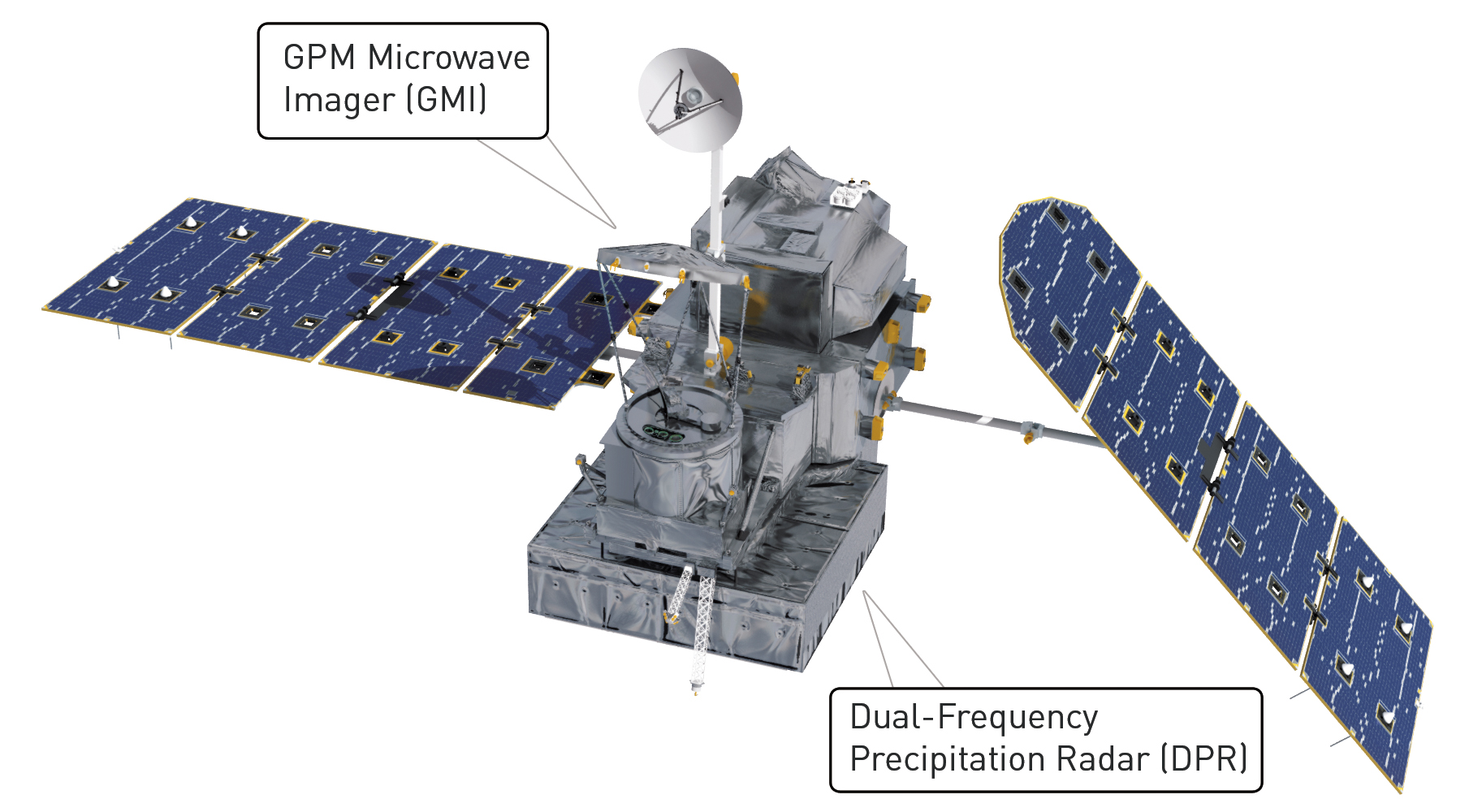
Image: GPM Core Observatory Diagram
Image Caption:
A diagram of the GPM Core Observatory showing the GMI and DPR Instruments.
Learn more about the GPM Core Observatory
Credits:
Britt Griswald, Jacob Reed
Article: Clouds and the Earth's Radiant Energy System (CERES)
Article: Lightning Imaging Sensor (LIS)
The Lightning Imaging Sensor is a small, highly sophisticated instrument that detects and locates lightning over the tropical region of the globe. Looking down from a vantage point aboard the Tropical Rainfall Measuring Mission (TRMM) observatory, 250 miles (402 kilometers) above the Earth, the sensor provides information that could lead to future advanced lightning sensors capable of significantly improving weather "nowcasting."
Article: Precipitation Radar (PR)
The Precipitation Radar was the first spaceborne instrument designed to provide three-dimensional maps of storm structure. These measurements yield invaluable information on the intensity and distribution of the rain, on the rain type, on the storm depth and on the height at which the snow melts into rain. The estimates of the heat released into the atmosphere at different heights based on these measurements can be used to improve models of the global atmospheric circulation.
Article: TRMM Microwave Imager (TMI)
The Tropical Rainfall Measuring Mission’s (TRMM) Microwave Imager (TMI) is a passive microwave sensor designed to provide quantitative rainfall information over a wide swath under the TRMM satellite. By carefully measuring the minute amounts of microwave energy emitted by the Earth and its atmosphere, TMI is able to quantify the water vapor, the cloud water, and the rainfall intensity in the atmosphere. It is a relatively small instrument that consumes little power.
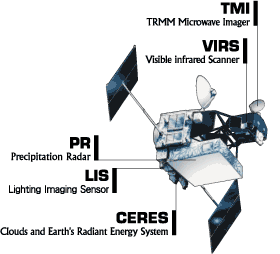
Image: Diagram of the TRMM Satellite and Instruments
Image Caption:
Diagram of the TRMM satellite and instruments.
Learn more about TRMM instruments
Credits:
NASA