


May 9, 2024, 8:00 p.m. ET
Register Here
Overview
In this webinar we will explore Earth’s weather and climate through the lens of NASA. Learn the difference between weather and climate, why it’s challenging to accurately predict the weather, and explore different weather and climate models. Also, learn how NASA’s “Earth to Sky” program is engaging with interpreters across the U.S. to...
Image

Image

Image

Image

Image

NASA satellite precipitation data is made freely available to all researchers who wish to use it. Visit this section for a directory of data products, documentation, training materials and more.
1997 - 2015
2014 - Present
NASA’s Global Precipitation Measurement Mission (GPM) uses satellites to measure Earth's rain and snowfall for the benefit of mankind. Launched by NASA and JAXA on Feb. 27th, 2014, GPM is an international mission that sets the standard for spaceborne precipitation measurements. Using a network of satellites united by the GPM Core Observatory, GPM expands on the legacy of the Tropical Rainfall Measuring Mission (TRMM) by providing high quality estimates of Earth’s rain and snowfall every 30 minutes. Learn More
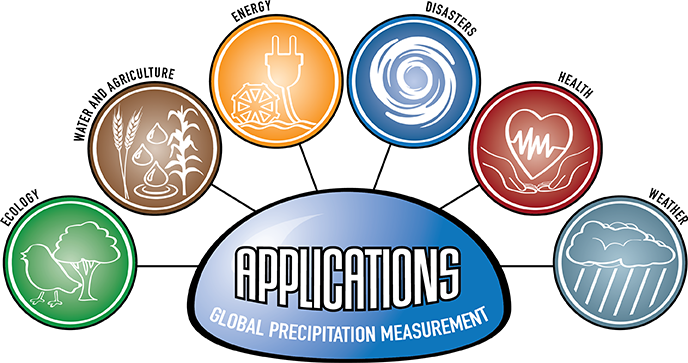
Learn how GPM datasets are being used by government agencies and other organizations around the world to study natural disasters, public health, freshwater resources, and a variety of other application areas.
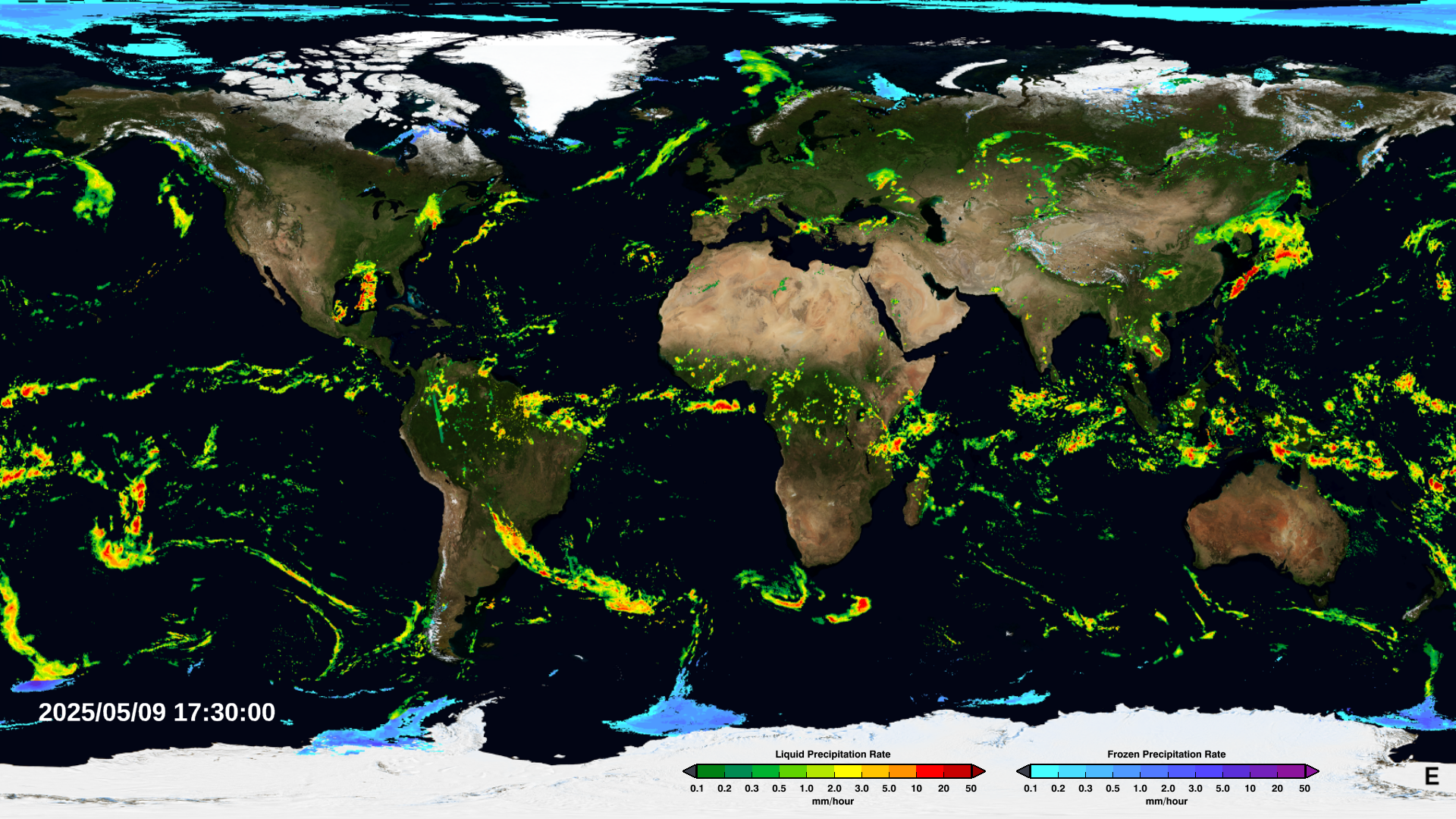
Near Real-time IMERG
Latest Half-hour of Earth's Precipitation
The Integrated Multi-satellitE Retrievals for GPM product combines precipitation observations using infrared and microwave sensors from a constellation of partner satellites, united by the GPM Core Observatory, to provide near real-time half-hourly precipitation estimates at 10km resolution for the entire globe.
Related Projects
LANDSLIDES @ NASA
NASA scientists are building a catalog of landslides so we can be prepared when the next natural disaster strikes. Join our citizen science project to help track landslides and improve prediction models.

NASA Disasters Program
The NASA Earth Applied Science Disasters program area promotes the use of Earth observations to improve prediction of, preparation for, response to, and recovery from hazards and disasters.

GLOBE Observer
An international citizen science initiative to understand our global environment. Your observations help scientists track changes in clouds, water, plants, and other life in support of climate research.
Upcoming Events
Feb. 27, 2024
10th Anniversary of the Launch of the GPM Core Observatory
April. 11, 2024
GPM 10-in-10 Webinar: Understanding and Protecting Earth
Virtual