
- Home
- GPM
- TRMM
-
Science
- Science Overview
- Research Topics
- Storm Structure and Mesoscale Dynamics
- Precipitation Microphysics
- Global Water Cycle
- Climate Change
- Precipitation Algorithms
- Radar Algorithms
- Radiometer Algorithms
- Combined Algorithms
- Multi-Satellite Algorithms
- Applications
- Meetings
- Data Access
- Resources
- Education
Keyword: C3VP
Mission News: Snowflakes!
Post Date:
01/26/2012
Summary:
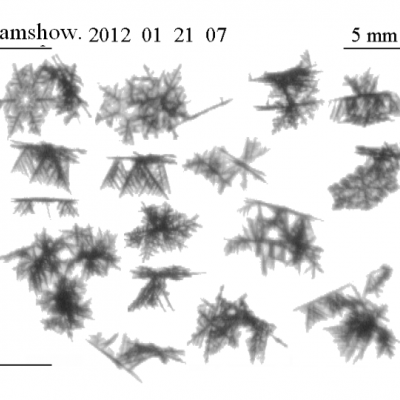
This image of falling snowflakes was taken by the Snow Video Imager (SVI) at one of the auxiliary ground sites, the Steamshow Fairgrounds, 5 miles (8km) south of the main CARE site, during a light snowfall on Saturday, January 21. The SVI is set up about two feet off the ground and the snowflakes are falling from top to bottom through the frame. They can be seen here in different three-dimensional orientations at 5x magnification.
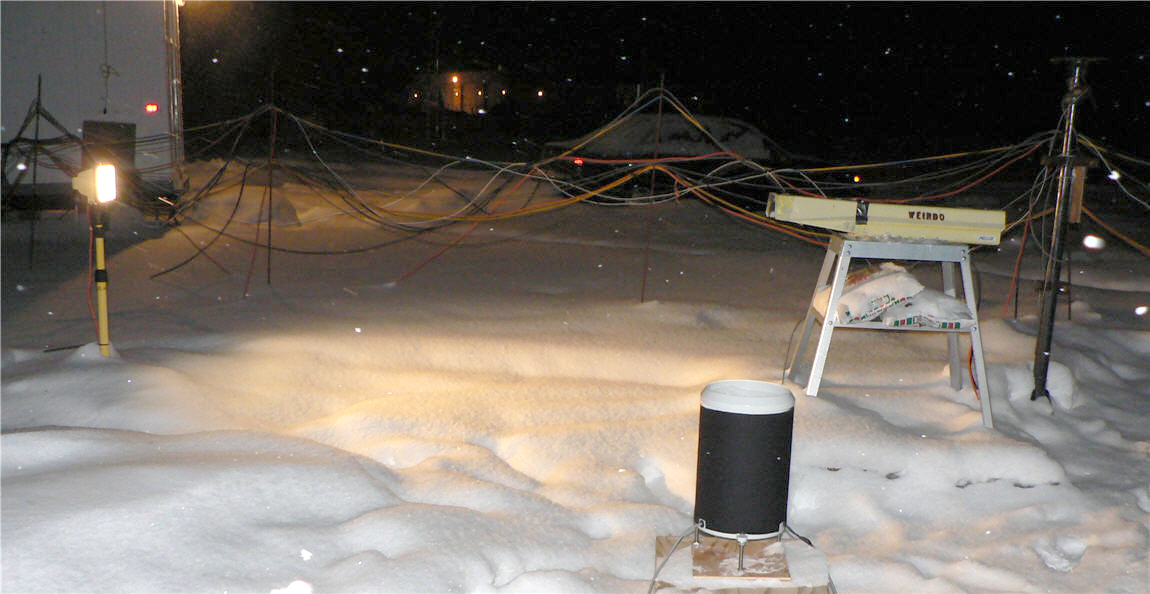
Image: Snow Video Imager (SVI) Instrument at C3VP
Image Caption:
The Snow Video Imager (SVI) set up to record snowfall during the C3VP Campaign.
The SVI is also being used during the GCPEx field campaign.
Credits:
NASA / Gail Skofronick-Jackson
Article: Ground Validation Data Access
Access to LPVEx data
A significant portion of the LPVEx dataset is now available for access via the GPM GV data archive at the GHRC DAAC, and by SFTP at the CloudSat GV data archive at CSU CIRA. A formal announcement for release of the complete dataset will occur no later than December 2011. Contact Walt Petersen for more information.
Document: NASA GPM/PMM Participation in the Canadian Cloudsat / Calipso Validation Project (C3VP): Physical Process Studies in Snow
Document File:
A complete understanding of the Earth’s hydrologic cycle necessarily dictates an ability to accurately quantify the global range of precipitation rates and types (rain, snow etc.). In turn, global observations of precipitation are most efficiently made from space. Great strides in the measurement of global tropical rainfall have occurred recently as a result of the NASA Tropical Rainfall Measurement Mission (TRMM).
Document: C3VP 2007 IOP3 Case Summary
Document File:
n all, 9 snowfall events were observed during IOP-3. All of these events were observed by the King City radars, 8 of the events were observed by the University of Massachusetts 3-frequency (W-, Ka, and Ku-band) Advanced Multi-Frequency Radar (AMFR), and 3 of the events were also observed with Convar-580 overflights.
This document is a case summary of the dates, times, snowfall types, and instruments used during these 9 IOP-3 snowfall events.
Document: Snowflake Size Distribution Measurements in South Central Ontario, Canada
Document File:
Parsivel Distrometer Results presented at the American Geophysical Union, Spring 2007.
Document: Parsivel (Laser Optical) Disdrometer
Document File:
Overview of the Parsivel instrument:
- Measures size and fall velocity of hydrometeors
- Present weather sensor
- Sampling area: ~50 cm2, varies with drop diameter
- Number of size and velocity bins: 32 x 32 matrix
- Drop size range: 0.06-24.5 mm
- Velocity range: 0.05-20.8 m/sec
- Operation period at Wallops Island: Spring 2002 - present
- Manufacturer: OTT in Germany www.ott-hydrometry.de
Document: Annex K: Canadian CloudSat/CALIPSO Validation Project (C3VP) Data Protocol
Document File:
Protocol for C3VP data.
Document: Disdrometer Derived Z-S Relations in South Central Ontario, Canada
Document File:
During the winter of 2006-2007, a number of in-situ and remote sensing precipitation measuring devices were operated at the Center of Atmospheric Research Experiment (CARE) site located near Egbert, Ontario about 30 km to the NW of the King City C-band operational dual-polarized radar. While the experiment was originally designed to measure winter precipitation for the Canadian Cloudsat/CALIPSO validation program (C3VP), the NASA’s Global Precipitation Measurement (GPM) ground validation program joined the efforts (cf.
Document: C3VP Access Information
Document File:
A summary of C3VP data access.